Donor records, beneficiary files, health information, financial data: if you cannot see it, you cannot protect it. Here's why identifying your sensitive data is the most important compliance step your organisation can take right now.
Not-for-profits are built on trust. Donors trust you with their financial details. Beneficiaries trust you with their most personal circumstances. Volunteers trust you with their identities. That trust is your most valuable asset.
However, most not-for-profits do not realise how much sensitive data is scattered across their Microsoft 365 environment. In a typical not-for-profit organisation, sensitive data includes:
- Donor personally identifiable information (PII) – names, addresses, payment details, giving history.
- Beneficiary records – case notes, health conditions, family circumstances, support plans.
- Financial information – bank account details, grant acquittals, payroll records, tax file numbers (TFNs).
- Volunteer and staff data – police checks, employment contracts, medical disclosures, working with children clearances.
- Health information – particularly relevant in aged care, disability, and community health sectors.
- Legal and contractual documents – funding agreements, service contracts, insurance policies, board resolutions and governance minutes.
Over time, this sensitive information accumulates in unexpected places: a volunteer coordinator's OneDrive folder, a decade-old shared mailbox, a Teams channel that was never properly governed, a SharePoint library that has never been audited since it was set up. Without a systematic approach to finding this data, organisations remain exposed to data breaches, regulatory penalties, reputational harm, internal data misuse, and failed audits.
The truth is that most not-for-profits are flying blind on where their sensitive data actually lives. And in an era of rising cyber threats, tightening privacy regulations, and growing funder scrutiny, that blind spot represents a risk you can no longer afford to ignore.
Unlike their corporate counterparts, not-for-profits often operate with lean IT teams, limited budgets, and a workforce mix of permanent staff, part-time employees, and volunteers; each potentially creating, sharing, and storing data across your Microsoft 365 environment in ways that are impossible to manually track.
Why manual audits do not work
Many organisations attempt to address data governance through periodic manual audits, such as asking staff to review their files, sending reminders about data policies, or relying on anecdotal knowledge of where things are stored. While well-intentioned, this approach is fundamentally flawed:
- Scale Problem.
A mid-sized not-for-profit with 150 staff can have millions of files across SharePoint, OneDrive, and Exchange. Manually reviewing even a fraction of these is impractical, and the most sensitive data is often buried in unexpected places that manual processes simply will not surface. - Ongoing Problem.
Even if you could conduct a comprehensive manual audit today, new data is constantly created, shared, and moved. Without automated, continuous scanning, your audit is out of date the moment it is completed. - Visibility Problem.
Staff do not always recognise what constitutes sensitive data. A volunteer coordinator who includes a beneficiary’s health condition in a routine Teams message may not realise they have just created a compliance risk. Automated tools catch what humans miss.
How Microsoft Purview Solves the Visibility Problem
Microsoft Purview is a powerful data governance and protection platform built natively into Microsoft 365. Rather than adding yet another tool to your environment, it works across the platforms your team already uses (e.g. SharePoint, Teams, OneDrive, and Exchange) to automatically discover, classify, and protect sensitive information at scale.
For not-for-profit organisations, Microsoft Purview delivers four critical capabilities:
| Automated Sensitive Data Discovery | Purview uses machine learning and built-in classifiers to scan your entire Microsoft 365 environment, identifying sensitive content such as donor PII, financial records, and health information, even in places you did not know to look. |
| Intelligent Classification and Labelling | Once identified, sensitive content is classified by sensitivity level and labelled consistently, making it far easier to apply protection policies and maintain governance standards across your organisation. |
| Data Loss Prevention (DLP) | Purview can automatically block or issue warnings when sensitive data is about to be shared externally or inappropriately, acting as an automated safety net that doesn't rely on staff remembering the rules. |
| Compliance Insight and Monitoring | Gain clear visibility into how data is being used, who is accessing it, and whether your protection policies are working, giving you the evidence you need for audits, board reporting, and funder accountability. |
If any sensitive data in your organisation were exposed tomorrow, whether through a breach, a misrouted email, or a disgruntled former volunteer, would you be able to demonstrate what controls you had in place? Microsoft Purview, implemented with the right partner, gives you that answer.
Don't Wait for a Breach: Start with a Sensitive Data Discovery Workshop
A breach does not give you a warning, but this workshop does. Professional Advantage offers a 3-Day Sensitive Data Discovery Workshop specifically designed for not-for-profit executives, to give you a clear picture of where your sensitive data lives before something goes wrong.
Delivered virtually via Microsoft Teams, this workshop provides your leadership team with:
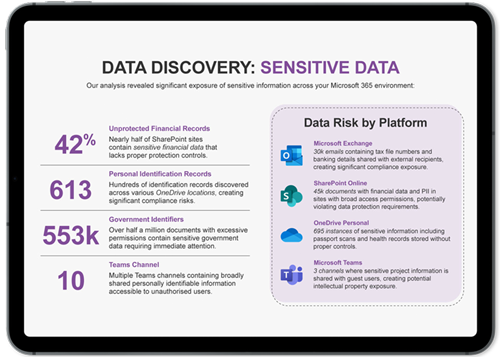
- Automated scanning and analysis of your actual Microsoft 365 data to locate sensitive, confidential, or personal information.
- An executive summary showing exactly where high-risk data lives across your environment – in plain language, not technical jargon.
- Strategic recommendations to reduce risk, strengthen compliance, and protect your community.
- Actionable next steps you can implement immediately, without needing to increase IT headcount.
Is this workshop relevant to your role?
Sensitive data governance goes beyond an IT concern. If your title falls into any of the following categories, this is directly relevant to your accountability:
- CEO / Executive Director – Ultimately responsible for organisational risk and stakeholder trust.
- CIO / IT Manager – Responsible for the security posture of your Microsoft 365 environment.
- Compliance Lead / Privacy Officer – Accountable for regulatory compliance and data handling standards.
- CFO / Finance Manager – Steward of sensitive financial data and funder accountability.
- Board Member – Governance oversight of organisational risk management.
Visibility is the Foundation of Trust
Your not-for-profit exists to make a difference in the lives of the people you serve. The trust that donors, beneficiaries, and communities place in you is not abstract. It is embedded in every record, every file, and every piece of data you hold. Protecting that data is not just a compliance exercise. It is an expression of your values.
The good news is that with the right tools and partner, achieving meaningful visibility into your sensitive data is not as complex or costly as it might seem. Microsoft Purview provides the technology. Professional Advantage provides the expertise. Together, we give your not-for-profit the clarity and control it needs to operate with confidence.
The first step is simply knowing where your data lives. Everything else flows from there.