


You have likely heard about Shadow IT, which refers to the use of unsanctioned applications and tools for work purposes that fall outside of IT’s approval. But as artificial intelligence (AI) becomes a common part of daily workflows, a new challenge has emerged: Shadow AI. AI tools like ChatGPT, Claude, Grok, or Gemini can be incredibly useful, but when used without governance, they can expose your organisation to serious security, privacy and compliance risks.
What is Shadow AI?
Shadow AI refers to the unauthorised or unmanaged use of AI tools within an organisation. Similar to shadow IT, it occurs when employees enable or experiment with AI capabilities without undergoing a formal IT approval or security review.
This creates a lack of visibility into how AI is used and where data is going, a risk that recently became all too real. A privacy breach at the NSW Reconstruction Authority exposed the personal information of more than 3000 individuals after a contractor uploaded sensitive data into ChatGPT. The breach disclosed the names, addresses, email addresses, phone numbers, and other personal and health-related information of program applicants.
Shadow AI typically arises within an organisation due to:
- Low awareness of data privacy and compliance risks.
Many employees are unaware that uploading work documents or entering sensitive data (such as client information, financial details, or personal identifiers) into public AI platforms can lead to data leaks or breaches. - Lack of accessible, sanctioned AI tools.
When organisations do not offer approved AI platforms or clear guidelines for use, employees will experiment on their own. Without a company-provided tool (e.g., Microsoft Copilot with proper data protection), they resort to public models that are not governed or monitored. - Slow or restrictive IT approval processes.
Employees often turn to public AI tools (like ChatGPT or Claude) when official IT channels take too long to approve or provide access to AI solutions. They want quick answers or automation, so they bypass formal processes, creating shadow AI use outside governance controls.
What are the Risks of Shadow AI?
Top Key Risks of Shadow AI
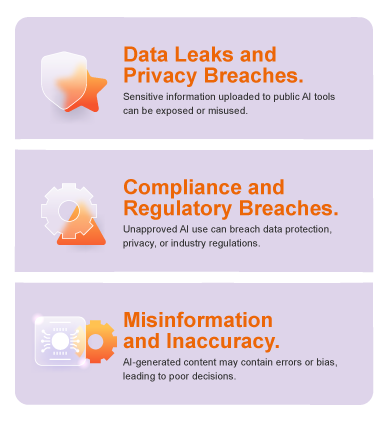
Without IT oversight, shadow AI can introduce significant organisational risks:
- Data leaks and privacy breaches.
Uploading sensitive or confidential information (such as client data, financial records, internal documents, etc.) into public AI tools can expose that data to external servers, where it may be stored, logged, or used for model training. This can violate privacy laws, such as the Privacy Act or GDPR, and lead to reputational damage. - Compliance and regulatory breaches.
Shadow AI usage can easily bypass established data governance, cybersecurity, and compliance controls. This creates potential breaches of frameworks such as ISO 27001, the Essential Eight, or internal data-handling policies, mainly when regulated data (e.g., health, financial, or personal data) is involved. - Misinformation and inaccuracy.
Generative AI can “hallucinate” or produce incorrect, fabricated, or biased information. When staff rely on AI-generated output without validation, it can lead to poor decision-making, compliance errors, or public misinformation.
What can you do about Shadow AI?
AI-powered workplaces are here to stay, which is why organisations must take a proactive approach to managing and mitigating shadow AI risks. The goal is not to eliminate AI use, but to bring it under responsible governance, allowing innovation to thrive safely and securely.
Here’s how organisations can manage Shadow AI effectively:
-
Educate and upskill employees.
Invest in awareness programs that help employees understand the difference between consumer-grade and enterprise-grade AI. Training should cover what data is safe to share, how to use AI responsibly, and the organisation’s AI policy. Empower staff to innovate safely, not secretly.
-
Strengthen data governance and information protection.
Before adopting AI broadly, organisations must ensure data is classified, labelled, and protected. Solutions like iWorkplace, Microsoft Purview, and Defender for Cloud Apps enable organisations to detect unsanctioned AI use, apply Data Loss Prevention (DLP) controls, and ensure sensitive information does not leave the corporate boundary.
-
Establish a Responsible AI Policy.
Leaders should define what is acceptable when using generative AI, including approved tools, data types that can be shared or not, and required security settings. A clear Responsible AI Policy helps employees understand boundaries while still promoting trust and accountability.
-
Provide secure, approved AI alternatives.
When employees have access to trusted tools, they will not need to look elsewhere. Microsoft 365 Copilot, for example, delivers the benefits of generative AI while ensuring your data remains within your secure Microsoft ecosystem.
-
Foster a culture of innovation with accountability.
Instead of banning AI outright, encourage responsible experimentation through AI sandboxes or innovation hubs where staff can test use cases securely. Involve business leaders, compliance officers, and IT professionals in evaluating outcomes to strike a balance between innovation and control.
From Shadow AI to Responsible AI
Shadow AI is not a sign of rebellion. It’s a sign that employees are eager to innovate. The challenge for leaders is to enable the responsible use of AI by providing the right tools, guidance, and governance.
By combining strong information management and compliance foundations with secure AI solutions like iWorkplace and Microsoft 365 Copilot, organisations can confidently embrace AI while maintaining data protection, regulatory compliance, and trust.
At Professional Advantage, we help organisations set the right information structure and guardrails for responsible AI use. With the proper governance in place, you can empower your people to innovate securely and productively.
Want to learn more about how to switch from Shadow AI to Responsible AI? Sign up for your 30-minute complimentary AI Strategy Call today to speak with one of our experts.



Write a Comment